
English
Views: 0 Author: Site Editor Publish Time: 2026-07-20 Origin: Site


Commercial power projects rarely have a simple load profile. HVAC systems, elevators, pumps, refrigeration equipment, data infrastructure, and EV chargers can create very different operating peaks, making transformer selection more complex than choosing a kVA rating. A three-phase pad mounted transformer can provide secure, ground-level power distribution for these demanding sites, but its capacity, voltage, feed arrangement, protection, and installation conditions must work together. Understanding these factors helps project teams avoid oversizing, voltage problems, coordination conflicts, and costly site changes before equipment is ordered.
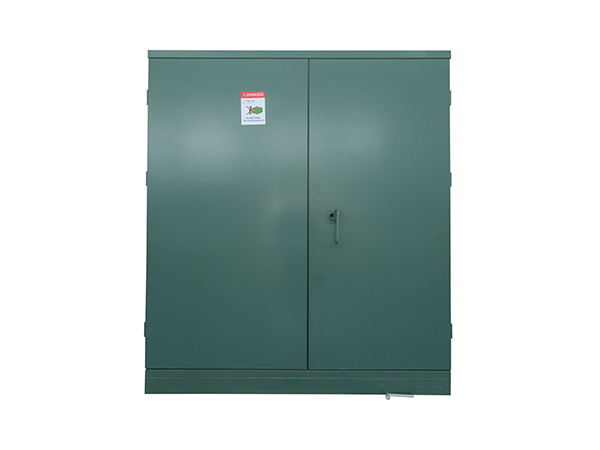
Commercial facilities seldom present one steady electrical load. Central HVAC equipment, elevators, pumps, refrigeration compressors, motors, commercial kitchens, UPS systems, and fast chargers may operate on different schedules and create very different peaks. Three-phase distribution suits these properties because it can serve substantial balanced loads and large rotating equipment without forcing the entire facility into one simplified demand assumption. The load schedule should therefore separate continuous demand, intermittent peaks, motor starting, seasonal use, and planned tenant additions instead of showing only a connected total.
The transformer must also be evaluated with the switchgear, feeders, grounding, protection, emergency-power arrangements, and allowable voltage drop. A pad mounted transformer that appears adequate by capacity alone may still conflict with breaker ratings, feeder distances, or operating requirements.
The strongest use case combines underground utility service, meaningful three-phase demand, suitable outdoor space, and a desire to avoid an indoor transformer room. A locked enclosure can place voltage transformation close to the load center while keeping inspection and service access outside occupied areas. This may reduce low-voltage feeder length and visual clutter.
Flood exposure, poor drainage, inadequate clearances, restricted lifting access, vehicle traffic, or a nearby noise-sensitive boundary can make the location unsuitable. These constraints should be reviewed before the electrical layout is fixed.
A compact property may use one central unit feeding the main electrical room. A larger campus may benefit from several transformers located near separate buildings or load clusters. Distributed units can reduce secondary feeder length, control voltage drop, support phased construction, and limit maintenance interruptions, but they also require more foundations, protection, and utility coordination.
The correct comparison is total installed and operating cost. One large transformer may become expensive once long feeders and outage exposure are included, while several smaller units may add needless complexity where loads are concentrated.
Capacity should begin with calculated maximum demand, not the simple sum of every nameplate. Demand and diversity factors reflect that lighting, HVAC, receptacles, motors, charging equipment, and tenant systems do not all operate at full output simultaneously. The calculation should also consider continuous loading, ambient temperature, harmonics, temporary overload expectations, the largest motor start, and realistic growth. For tenant-driven developments, the engineer should separate known loads from allowances so speculative expansion does not dominate the selected rating.
Undersizing can cause excessive temperature rise, poor voltage performance, faster insulation aging, and little room for expansion. Excessive oversizing can increase purchase cost, footprint, and no-load losses over years of continuous energization. The preferred rating is the smallest practical size that can carry expected demand, starting conditions, and justified future load within thermal and voltage limits. This rating should remain acceptable under normal operating scenarios, not only under a single theoretical peak.
JSYW three-phase units are available for commercial parks, industrial estates, and medium-voltage distribution centers, including 2,500 kVA and 5,000 kVA configurations with different voltage combinations. These capacities illustrate the range of commercial applications, but neither should be treated as a default without a completed load study.
Primary voltage must match the utility supply, while secondary voltage must suit the building distribution equipment and connected loads. Winding connection affects neutral availability, grounding, phase-to-ground voltage, fault behavior, and downstream compatibility. These details should be settled on the single-line diagram before procurement.
Off-circuit taps can adapt the ratio to expected supply conditions, but they do not replace a voltage study. Impedance influences available short-circuit current, breaker interrupting ratings, motor-starting voltage drop, protective-device coordination, and arc-flash results. Lower impedance can improve regulation but raise fault current; higher impedance can limit fault current while increasing voltage drop. The proposed rating should therefore be checked through load-flow, short-circuit, coordination, and grounding studies.
Project input | How it affects the specification |
Maximum demand | Establishes required capacity |
Continuous load | Influences thermal loading |
Largest motor or HVAC load | Helps assess starting voltage drop |
Utility primary voltage | Determines the high-voltage winding |
Building distribution voltage | Determines the secondary configuration |
Available fault current | Affects impedance and equipment ratings |
Harmonic-producing equipment | May increase winding and neutral heating |
Planned expansion | Defines a justified capacity allowance |
Preliminary estimates can support budgeting, but final procurement should use confirmed utility conditions, load data, and fault-current information. This reduces late changes to taps, impedance, terminations, and protection.
A radial-feed arrangement uses one incoming primary path and is generally simpler to operate and protect. Loop feed adds switching flexibility within an underground network, allowing a cable section to be isolated and service restored from another direction when the wider system supports it.
Loop feed does not guarantee uninterrupted power; continuity still depends on cable routing, sectionalizing, source availability, operating procedures, and response time. The choice should reflect outage tolerance, tenant criticality, and maintenance strategy. IEEE C57.12.34-2022 includes connector, bushing, and terminal arrangements for radial- and loop-feed three-phase pad-mounted systems.
Primary switches, expulsion fuses, current-limiting fuses, surge arresters, pressure-relief devices, and monitoring accessories perform different functions, but protection depends on coordination. Utility devices, transformer protection, and building switchgear must operate as one scheme; otherwise, a downstream fault may cause a building-wide outage.
The design team should define which device clears an internal fault, whether the unit can be isolated without interrupting adjacent loads, and who may operate the medium-voltage compartment. Fault current, interrupting ratings, and live-front or dead-front utility requirements must be verified together.
Liquid-immersed, self-cooled construction is common outdoors because the fluid provides dielectric insulation and transfers heat. Mineral oil remains common, while alternative fluids may be considered for fire, environmental, insurance, or site-risk objectives. Utility acceptance and thermal compatibility still require confirmation.
Core losses continue whenever the unit is energized, while winding losses rise with load. A commercial pad mounted transformer operating for long hours should therefore be evaluated through guaranteed losses rather than general efficiency claims. JSYW three-phase configurations support balanced loading, low-loss operation, stable thermal performance, secure enclosure construction, and project-specific oil-immersed designs for higher-capacity applications.
Civil and electrical coordination should begin before final drawings are released. The concrete pad must suit the equipment weight and footprint, remain level, provide correctly positioned cable openings, and account for soil conditions, drainage, flood elevation, ventilation, and working space. Parking, fire lanes, drainage, pedestrian routes, landscaping, and snow storage can conflict with an otherwise acceptable location.
Enclosure orientation must align with primary ducts, secondary conductors or busway, grounding, cable-bending space, terminals, and door swing. Access must remain available for utility crews, switching, inspection, oil sampling, lifting equipment, and eventual replacement. Screens or planting should never block airflow or prevent full compartment access. Transport, installation, and operating manuals should supplement approved drawings, local codes, and utility requirements.
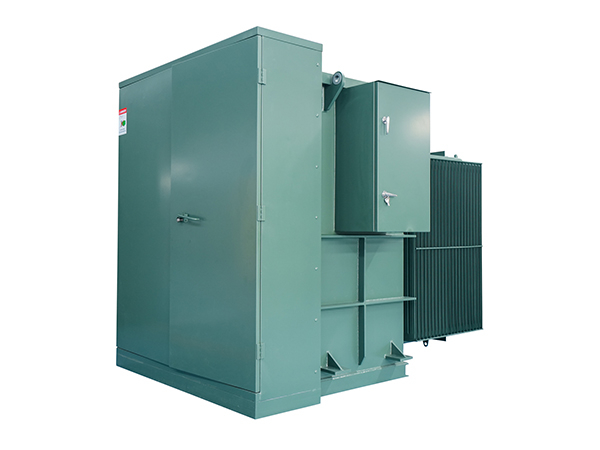
A purchase specification should state capacity, voltage ratio, frequency, winding connection, taps, impedance, radial or loop feed, high-voltage interface, protection, insulating fluid, enclosure construction, accessories, and environmental conditions. Add altitude, ambient temperature, corrosion, sound, seismic, monitoring, termination, and ownership requirements where applicable. Phrases such as “built to IEEE standards” are too vague because different standards and editions address different characteristics.
IEEE C57.12.34-2022 applies to three-phase, 60 Hz, liquid-immersed, self-cooled, pad-mounted compartmental-type transformers rated 10 MVA and smaller within its stated voltage limits. It addresses electrical, dimensional, mechanical, and certain safety characteristics, including radial- and loop-feed terminal arrangements, but not every accessory requirement. The specification should name the standard and edition while separately defining protection and monitoring devices.
Efficiency coverage also requires correct classification. U.S. Department of Energy regulations define covered liquid-immersed distribution transformers as 60 Hz units with an input voltage of 34.5 kV or less, an output voltage of 600 V or less, and a capacity from 10 to 2,500 kVA, subject to stated exclusions. A 5 MVA unit should not automatically be described as covered by the same provisions.
Approved documentation should include dimensional drawings, terminal layouts, nameplate data, wiring diagrams, guaranteed no-load and load losses, impedance, fluid data, accessory schedules, lifting information, and installation instructions. Routine verification may include winding resistance, ratio, phase relation, losses, impedance, dielectric tests, and leak or pressure checks where applicable. Reports must correspond to the purchased voltage ratio, capacity, winding arrangement, and enclosure.
Commercial evaluation should extend beyond purchase price. Losses affect energy cost, while maintenance access, replacement difficulty, spare-parts planning, and outage consequences shape lifecycle value. General technical literature can support the review, but approved drawings, utility comments, contractual guarantees, and order-specific test records remain controlling. Routine and type test records, along with installation manuals, should be requested for the exact unit being supplied.
Selecting a three-phase pad mounted transformer for a commercial project requires more than matching a kVA rating. Load behavior, voltage, impedance, feed configuration, protection, site conditions, and future expansion must be evaluated as one system. Jiangsu Yawei Electric Group Co., Ltd. offers configurable three-phase units that can be matched to project-specific capacity, voltage, enclosure, and distribution requirements. By coordinating these details before procurement, project teams can reduce installation changes, improve power reliability, control long-term losses, and create a transformer specification that supports both current demand and planned growth.
A: It steps down underground medium-voltage power to usable three-phase voltages for commercial equipment, including HVAC systems, motors, elevators, refrigeration, and charging infrastructure.
A: Size should reflect maximum demand, continuous loading, motor starting, harmonics, ambient conditions, and planned expansion. Connected load alone may produce an unsuitable rating.
A: Radial feed uses one incoming source and is simpler. Loop feed supports alternative switching paths, although reliability still depends on cable layout, protection, and operating procedures.
A: Yes, when correctly installed. Its locked enclosure limits access, but safe operation also requires proper grounding, drainage, clearances, protection, and controlled maintenance access.
A: Routine checks cover the enclosure, bushings, insulating fluid, grounding, connections, temperature indicators, and signs of leakage or overheating. Inspection frequency depends on loading and site conditions.
A: Three-phase units suit larger commercial and industrial loads requiring balanced power, while single-phase transformers are more common for residential or smaller, lower-capacity services.


